A few months ago, I saw a post on Hacker News about a study out of a Japanese music school (PDF) that claims to have a high success rate teaching children aged 2-6 to have perfect pitch. Their method involves associating the chords with colored flags and quizzing the children 4-5x daily for about 2 minutes per session. If it works, this seems like a cool skill to have, particularly since our kids seem fairly interested in music; Max is about to age out of the range of the study, so I figured I should make it a priority to get started sooner rather than later.
Since we don’t have a piano yet (and even if we had one it seems like it would be difficult to arrange to be near a piano 4-5 times per day for potentially a few years), I put together a simple web app using sounds I recorded with an online piano site, and started quizzing Max 4-5x per day about 3 weeks ago.
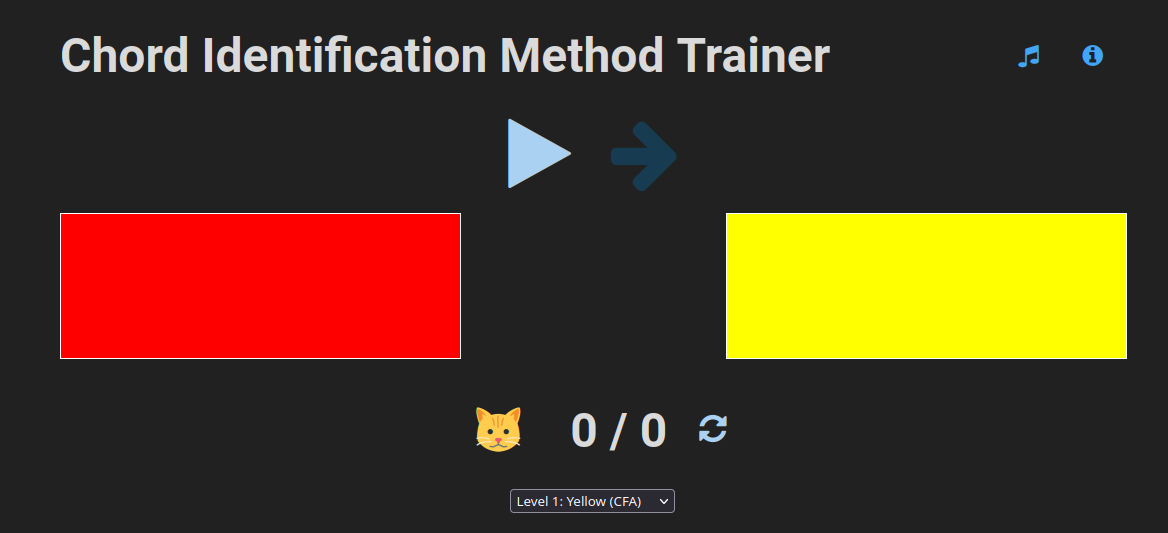
The verdict so far is that it’s going really well! At first Max saw it as something of a chore, and I sort of had to fight him to do it (not a great dynamic). He was still not entirely sold on the idea after I added a cat emoji that reacts to how well he’s doing, but eventually he came around. I think the major factors that made him start liking it were:
- When his friends would come over, I would say, “Max, do you want to show your friend your chord trainer?” And then he got to be the knowledgable one, explaining how to use the chord trainer. To encourage this, we created a Youtube video together explaining how to use it.
- He started getting good at it, and the pride of accomplishment fueled his interest. I think the first inkling of pride he got from this was when he noticed that he was better at it than his friends (because he had been using the trainer longer and more consistently than them). Then, one day last week, he got a perfect score, and was just blown away. After that, he was excited to “get blue” (move on to Level 2, which involves adding the blue chord); I told him he needed to be able to identify the red and yellow chords 100% every time for a whole day (or 5 times in a row) to get blue; after that he was excited to concentrate on the chord trainer to achieve his goal.
I was a bit afraid that once we got to blue he would feel that getting to black (the next chord) was too far away or too difficult and he’d lose interest, but he was actually really good at the next level (he got 90% this morning!), which has him excited to keep going.
A few general thoughts from my experience:
- It’s actually quite annoying to try to find 5 separate times to do the chord trainer every day, particularly when he’s at school and/or I’m at work for a large chunk of the day. Most days we end up just doing 4 sessions: as soon as we wake up, as soon as he gets back home from school, right before dinner and right before bed. Depending on when all that happens, I try and throw in one extra session.1
- It’s kind of important to be in a quiet environment, particularly if he’s not wearing headphones (and he’s rarely wearing headphones). This can be discouraging because it causes him to get a worse score than he gets in a quiet environment. If you have a separate room free of distractions, I recommend using it. If you can get into the habit of having high quality headphones around, that makes it easier to do the chord trainer in noisier situations (particularly out and about, e.g. on the phone).
- Having done the chord trainer with a few of the neighborhood kids, I find that Max’s failure mode tends to be that he goes too quickly and doesn’t listen carefully to the chords. Other kids are really interested in getting it right and listen carefully, but they seem to suffer from a bit of indecision and second-guessing themselves.
As with many of these sorts of long term projects (getting in shape, learning a language or a new skill), I think that consistency is key here, so I think the best thing to do is to just get started and find a schedule that works for you. I imagine that doing it 3x / day is better than not doing it at all, so if that’s the only thing you can make work, it’s probably best to do that rather than give up on the whole project.
Footnotes Link to heading
-
If, like us, you are training your child using a device that doesn’t have mobile connectivity, you may want to try to save the web app’s page for offline reading (on an iPad you can “Add to Reading List”, just make sure the setting to save reading list pages for offline reading is turned on). That way, you can have your child do the trainer by themselves on car trips or when you are out and about. ↩︎